

Nutritious Is Not Enough If Nobody Wants to Eat It

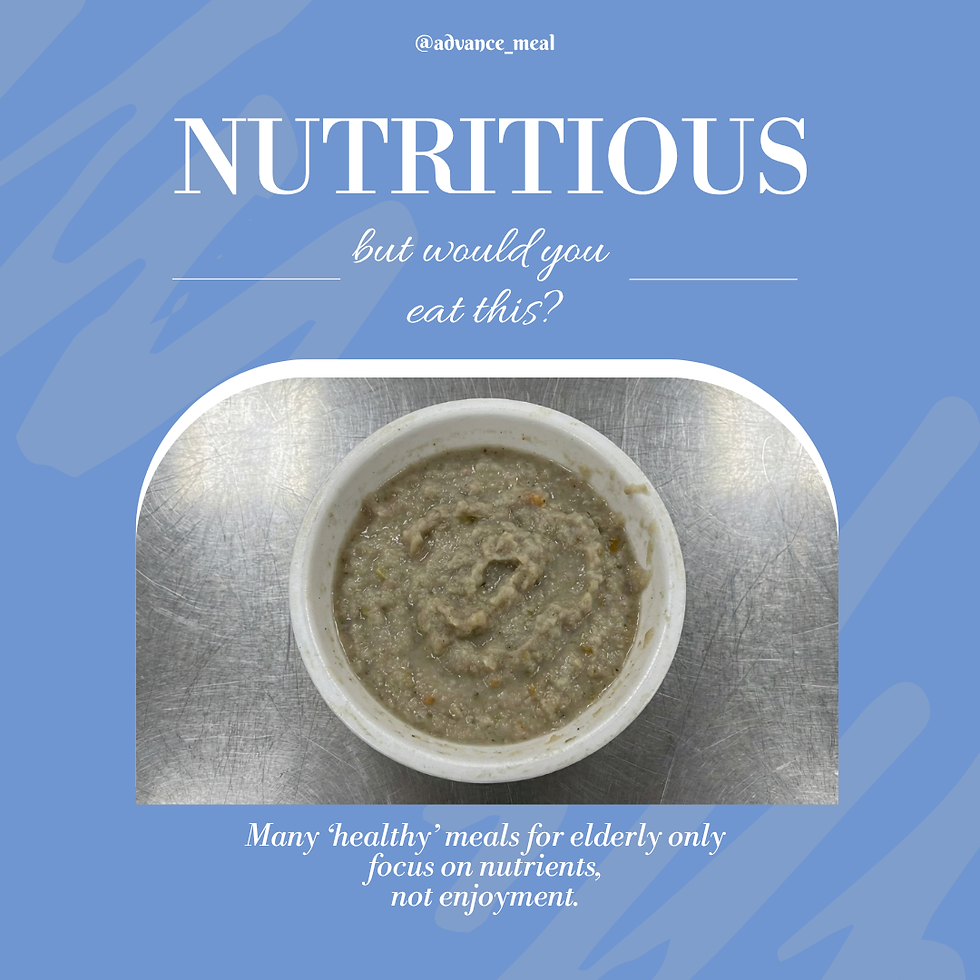
Walk through any hospital ward or care facility and you will often see the same thing: a tray of perfectly measured, nutritionally complete food sitting largely untouched. The calories are there. The protein is there. But the person at the table barely touched it.
This is one of the most underappreciated challenges in elderly nutrition. We have spent a great deal of energy calculating what elderly people need to eat, and far less considering whether they actually want to eat it.
The Problem with Food That Only Looks Like Medicine
Many meals prepared for older adults are optimised entirely for nutritional content, and almost never for enjoyment. The texture may be soft, but the food looks dull and tastes bland. It does not smell like anything in particular. It arrives as a beige or grey mass on a plate, and even someone with a healthy appetite would hesitate.
For elderly people who already experience reduced appetite, this is enough to tip the balance. They push the plate away, leave the food unfinished, and mealtime becomes a burden rather than a pleasure.
Appetite Is a Part of Nutrition
We often treat appetite as something separate from nutrition, as if one is a biological need and the other is a luxury. But appetite is not a luxury. It is the mechanism through which the body chooses to eat. When appetite fails, nutrition fails with it.
For elderly people in particular, the sensory experience of food matters enormously. Smell, colour, texture, and taste all send signals to the brain that make eating feel worthwhile. A meal that engages the senses, even in a small portion, is far more likely to be finished than one that does not.
Rethinking What a Healthy Meal for Elderly People Means
A genuinely healthy meal for an older adult is one that is both nutritionally complete and genuinely enjoyable to eat. Not one or the other. Both.
Advance Meal was built around this principle: a soft, high-protein healthy meal created specifically for older adults and people at risk of malnutrition, so that families no longer have to choose between nutritious and enjoyable. You can have both, in one bowl.


Comments